



Industrial Freezing Tunnels in Tunisia and Africa
Design, manufacture and installation of freezing tunnels
Afric Froid designs and installs freezing tunnels for fishing, meat, poultry, dairy products and ready meals. Air blown at −38 / −40 °C, product brought to −18 °C at the core, refrigeration units sized for 38 °C in the shade.
More than 120 tunnels built in Tunisia and Africa, including 24 on a single site in Gabès.

What is a freezing tunnel?
Once frozen, the products go into a frozen storage room at −20 / −25 °C. Freezing tunnel, blast freezer and blast freezing tunnel refer to the same equipment.
Freezing tunnel or frozen storage room?
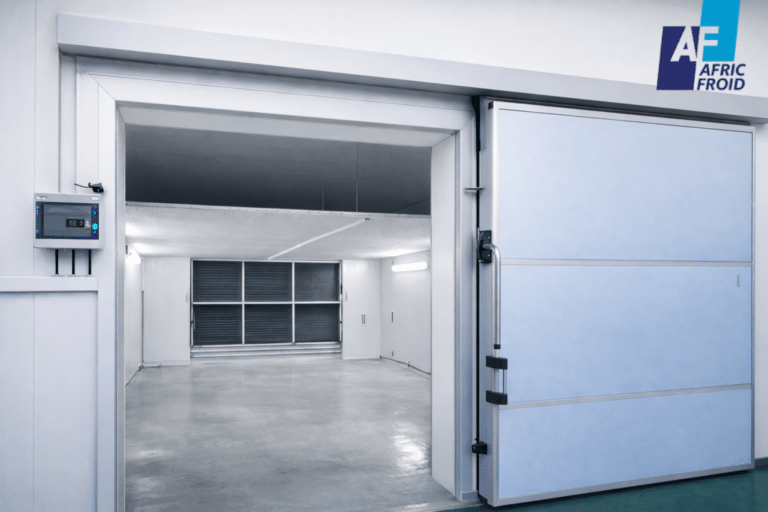
They do not do the same job:
| Freezing tunnel | Frozen storage room | |
|---|---|---|
| Role | freezes the fresh product | stores product that is already frozen |
| Air temperature | −35 to −40 °C | −18 to −25 °C |
| Airflow | very high, directed at the product | low, to hold the temperature |
| Cooling capacity | sized for the cycle load | sized for heat gains |
| Residence time | one cycle, a few hours | several weeks or months |
A frozen storage room has neither the capacity nor the airflow to freeze quickly: fish that freezes slowly there loses water and firmness when thawed.
Why freeze quickly?
Between about −1 and −5 °C, the water in the product turns into ice. If this happens slowly, large crystals form and tear the cells: when thawed, the product loses juice, weight and texture. A tunnel takes the product through this zone quickly and forms small crystals.
This is what quick freezing means: the product is frozen rapidly, then kept at −18 °C or below.
Which tunnel for which product?
Trolley or pallet tunnel
The most common type: load the tunnel, freeze, unload.
Products: fish and seafood in crates or cartons, meat, poultry, cheese, ready meals.
Capacity: from a few tonnes to 10 t per cycle.
Rapid chilling tunnel
A positive-temperature tunnel that brings a cooked product or a dough down to +2 / +4 °C without freezing it, for example in cheese making or ready meals.
Reference: two rapid chilling tunnels for an industrial cheese plant in Tunis.
IQF freezing
Piece-by-piece freezing, on a belt or a fluidised bed, for loose products that must not stick together: shrimp, diced vegetables, small fruit.
On request: please contact us.
Frozen storage room
After the tunnel, products are stored at −20 / −25 °C. In Gabès, 24 tunnels feed 7 frozen storage rooms at −24 °C.
See our cold rooms.
How an Afric Froid tunnel is built
High-airflow evaporator
Screw compressor with economiser
One refrigeration unit per tunnel
Condenser sized for 38 °C
The other parts of the tunnel

- Danfoss electronic expansion valve on each evaporator: it feeds the coil precisely while the load varies strongly between the start and the end of the cycle, and saves up to 20% energy compared with a thermostatic expansion valve.
- Electric defrosting of the evaporators, controlled by a sensor.
- Control by Danfoss AK-CC 750 controllers, and centralised monitoring of temperatures and alarms for HACCP traceability.
- Enclosure in polyurethane panels, 200 mm on the outer walls and 150 mm between tunnels, swing doors rated for −40 °C, a pressure relief valve on each tunnel.
- Refrigeration units assembled and wired in our workshops, then shipped to site, by container for export.
See our product pages: tunnel evaporator (7 to 107 kW at −40 °C), Bitzer HSN screw compressor and freezing tunnel.
Sizing a freezing tunnel

A tunnel is calculated from the product, not from the size of the room. To prepare a quote, we need:
- The product and its packaging: whole fish or fillets, meat, poultry; in crates, in cartons or unpacked; thickness.
- The load per cycle (in kg) and the number of cycles per day.
- The inlet temperature: +4 / +5 °C for a fresh product, much higher for a cooked product.
- The target core temperature (usually −18 °C) and the required cycle time.
- The site: maximum outdoor temperature, available space, power supply.
Order of magnitude. Freezing 5 t of fish from +5 to −18 °C means removing about 1,600 MJ, or 450 kWh, mostly to turn the water it contains into ice. Over a 10-hour cycle, that is about 45 kW on average for the product alone; on top of that come the heat from the fans, packaging and walls, and the peak at the start of the cycle. In Gabès, each 5 t tunnel has its own 44 to 51 kW compressor at −40 °C; in Dakar, 5 t and 10 t tunnels freeze their load in 8 to 12 hours depending on the product.
Our engineering department carries out the full heat load calculation and checks the core freezing time according to product thickness.
Our freezing tunnel projects
More than 120 freezing tunnels built in Tunisia and Africa, including:

Gabès (Tunisia), 2019 and 2022
24 tunnels of 5 t per cycle for a seafood plant, one Bitzer screw compressor per tunnel, 7 frozen storage rooms at −24 °C.
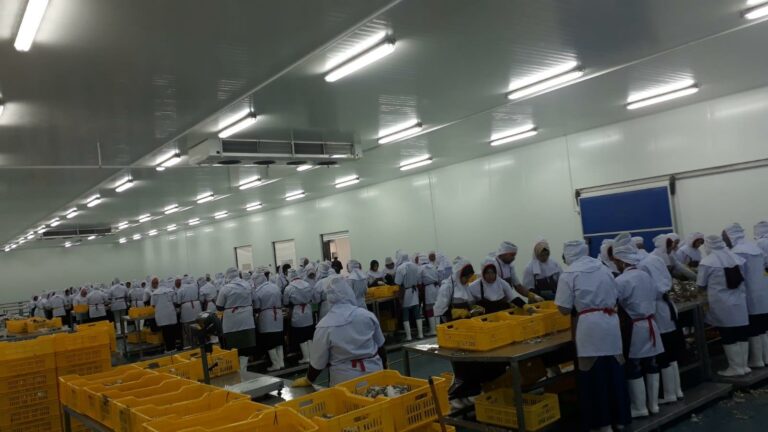
Djerba (Tunisia), 2023-2024
2 freezing tunnels of 8 t, 10 frozen storage rooms and 2 ice plants for a fish processing plant.

Tunis (Tunisia), 2024-2025
One freezing tunnel at −40 °C and two rapid chilling tunnels for an 85 t/day cheese plant.
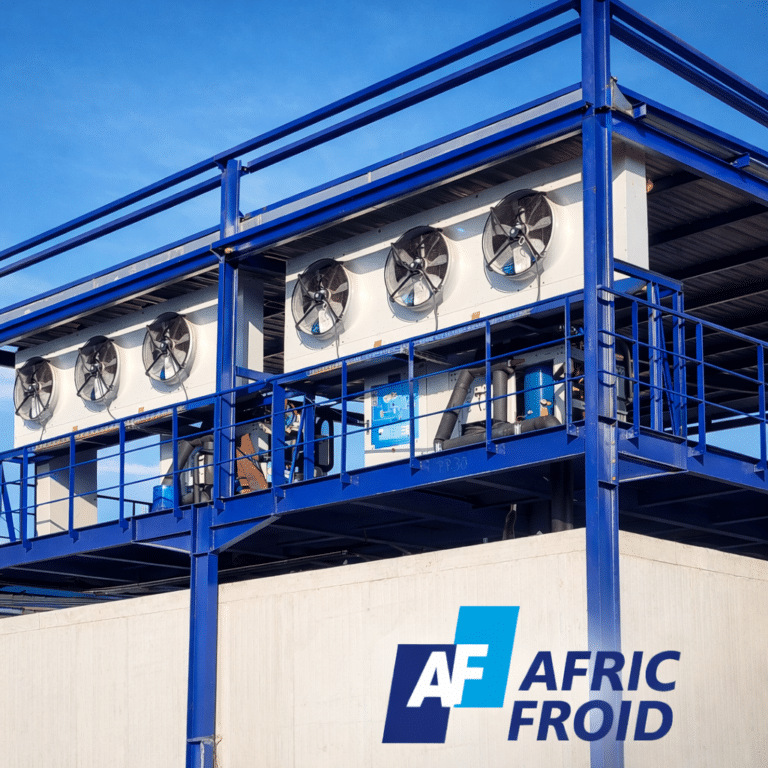
Dakar (Senegal)
4 tunnels at the fishing port, three of 5 t and one of 10 t, from +5 to −18 °C at the core in 8 to 12 hours.
From design to maintenance
Design and sizing
Manufacture and installation
Maintenance and 24/7 call-out
Freezing tunnels in Tunisia and Africa
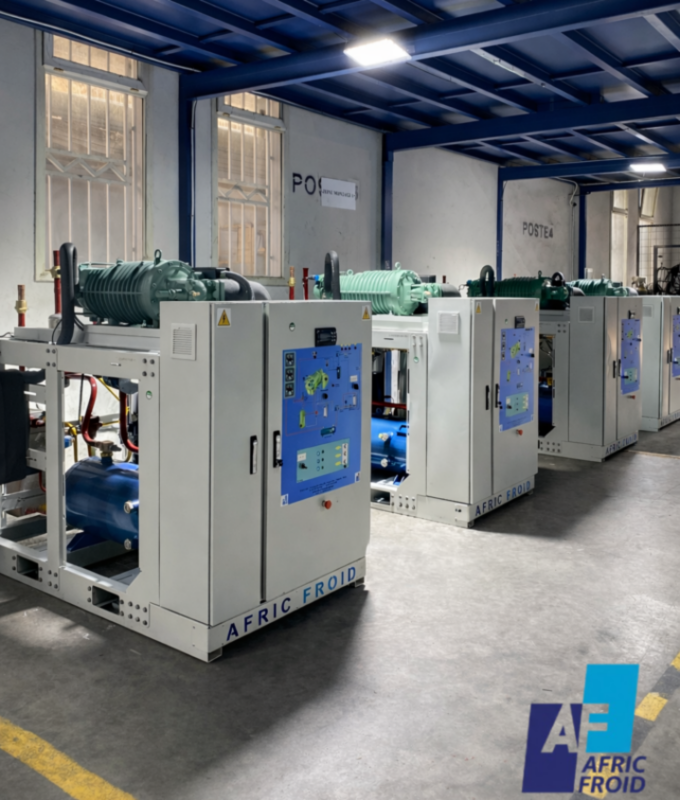
Afric Froid has been based in Tunisia since 1992 and works in 14 countries. Our units are sized for the heat of southern Tunisia and West Africa, and our teams install and commission them on site.
By sector: refrigeration for fishing and seafood, meat, poultry.
In West Africa: freezing tunnels in Senegal and freezing tunnels in Côte d’Ivoire.
Frequently asked questions
What is the difference between a freezing tunnel and a frozen storage room?
The tunnel freezes: it blows air at −35 / −40 °C at high speed to bring fresh product to −18 °C at the core within a few hours. The frozen storage room stores, at −18 / −25 °C, products that are already frozen. It has neither the capacity nor the airflow to freeze quickly.
What temperature is a freezing tunnel?
The air is at −35 / −40 °C, with evaporation at −40 / −42 °C. The product must reach at least −18 °C at the core before going into storage.
How long does a freezing cycle take?
It depends on the product, its thickness, its packaging and its inlet temperature. In Dakar, 5 t and 10 t tunnels of fish in crates freeze their load in 8 to 12 hours.
Freezing tunnel or blast freezer: what is the difference?
None in terms of equipment. Quick freezing means the product is frozen rapidly, then kept at −18 °C or below: that is exactly what the tunnel does.
Why a screw compressor?
At −40 °C evaporating temperature, the screw compressor with economiser keeps good capacity and handles the continuous operation of long cycles. Afric Froid has already supplied and installed more than 80 tunnels with screw compressors.
How much does a freezing tunnel cost?
It depends mainly on the load per cycle, the target cycle time, the product inlet temperature and site conditions. We carry out the heat load calculation and send you a detailed quote.


