


News & Projects
How to choose the best cold room for commercial or industrial use in Côte d’Ivoire
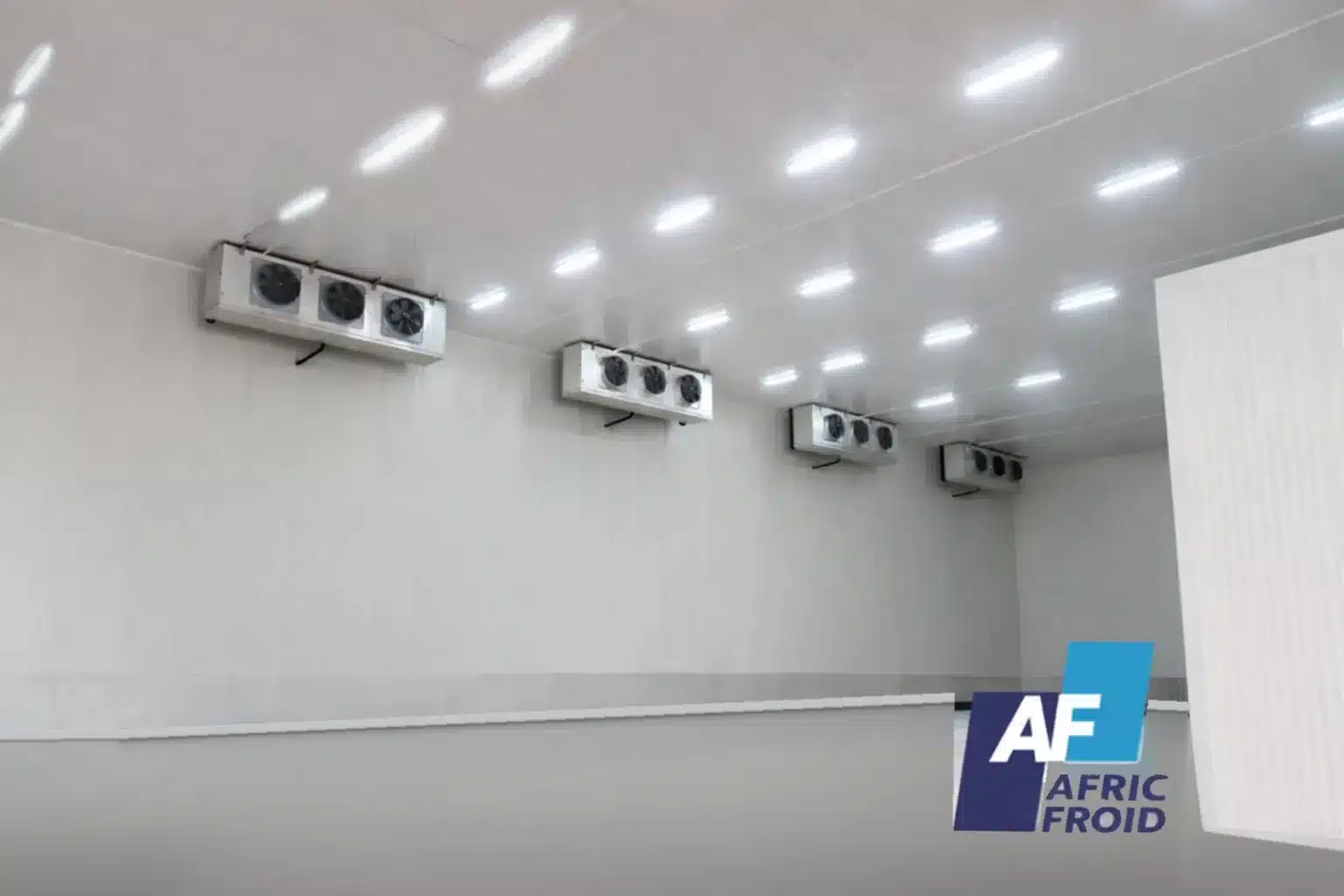
The cold room is essential equipment for many sectors in Côte d’Ivoire: food processing, fishing, catering, hospitality, retail, pharmaceuticals and fruit export. It guarantees the freshness, quality and food safety of sensitive products.
Choosing the right one means storing your products in good conditions while controlling energy use and running costs. In Abidjan’s hot, humid climate, an undersized cold room uses too much power, struggles at the hottest time of day and loses stock. Here are the criteria our design office checks before every project.
The main criteria for choosing the best cold room
Identify your real needs
Before investing in a cold room in Côte d’Ivoire, you need to know exactly what you will store in it. Our design office always starts from four pieces of information:
- the dimensions of the room, or the space you have;
- the storage temperature;
- the type of product: fruit, vegetables, meat, fish, dairy, drinks, medicines…;
- the quantities coming in each day, and their temperature on arrival.
That last point is often forgotten: cooling several tonnes of products delivered at ambient temperature every day needs far more capacity than keeping products that are already cold. For commercial use (supermarkets, restaurants, hotels, butchers, patisseries), a medium-sized room is often enough. For industrial use (processing plants, logistics warehouses, agricultural exporters), large-capacity rooms are chosen, sometimes several independent rooms so that nothing has to stop completely during servicing.
Choosing between a chilled and a frozen cold room
A chilled (positive) cold room keeps fresh products, a frozen storage (negative) cold room keeps frozen products. The choice depends on what you store and the cold chain your business requires:
| Chilled cold room | Frozen storage cold room | |
|---|---|---|
| Products | Fruit, vegetables, dairy, eggs, fresh meat, drinks | Frozen fish, meat and poultry, ice cream |
| Temperature | −3 °C to +12 °C depending on the product | −18 °C to −25 °C |
| Insulated panels | 80 to 120 mm | 150 to 200 mm |
| Door | Hinged or sliding | Thicker and sturdier |
A frozen storage room also needs pressure relief valves to protect the panels, and an evaporator with wider fin spacing and electric defrost. See our chilled and frozen cold rooms.
Adapt the cold room to the Ivorian climate
This is the criterion that makes the difference in Côte d’Ivoire. The refrigeration unit rejects the heat taken out of the room to the outside air: the hotter the air, the harder it works. In Abidjan, we design installations for 38 °C ambient and 70% relative humidity.
- The condenser is sized for high outdoor temperatures, placed in the shade in a well-ventilated spot and, near the sea or the lagoon, protected against salt air (see our article on fin protection for coastal sites).
- Insulation: thick enough panels and door seals in good condition limit heat gains.
- Humidity: humid air entering at each door opening turns into frost on the evaporator; a strip curtain or an airlock limits it.
Consider the available space and installation
Check the floor area and height available before choosing. Modular panel rooms fit most buildings and can be extended later. Also think about:
- access for loading and unloading: pallet truck, forklift, loading dock;
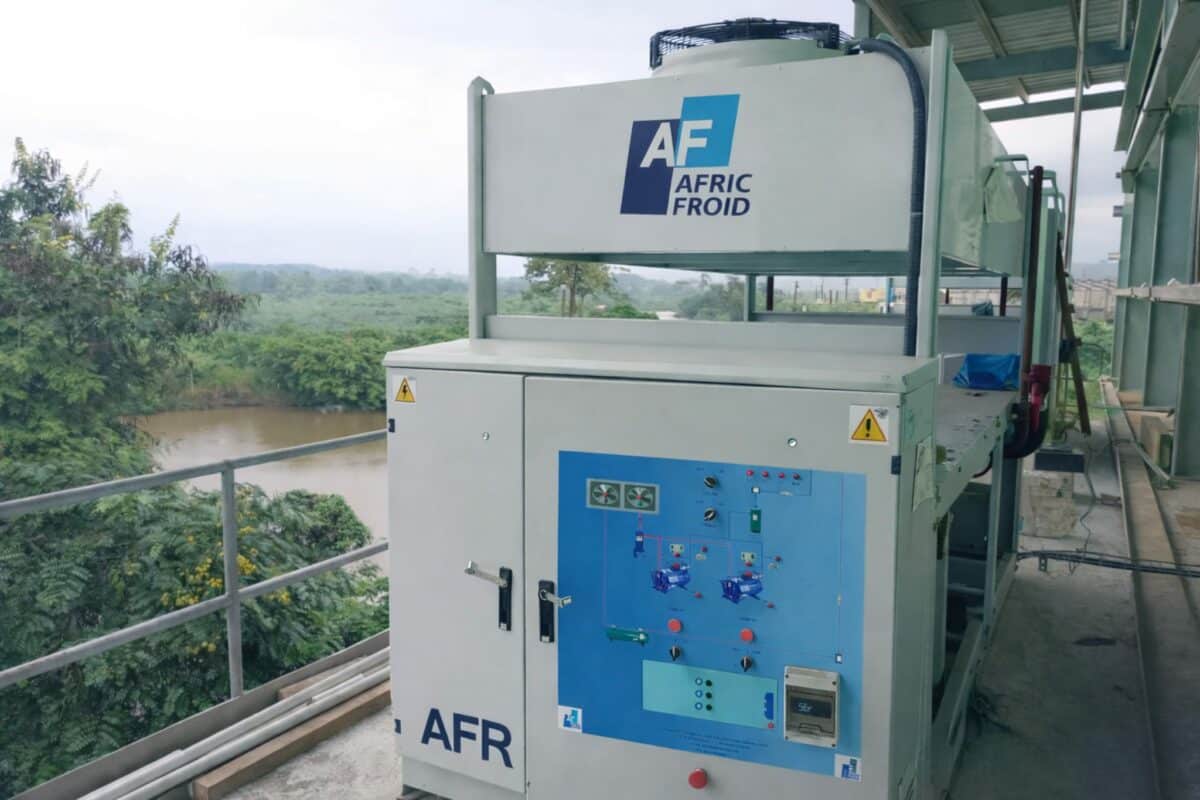
- where the condensing unit goes: outdoors, ventilated and easy to reach for maintenance;
- the floor, which must be insulated in a frozen storage room;
- the electrical power available on site.

Energy consumption
In Côte d’Ivoire, electricity is a large part of the cost of a cold room, whose unit runs all year round. On our installations, we achieve up to 30% energy savings by combining three techniques:
- electronic expansion: a Danfoss AKV electric expansion valve, driven by a controller such as the AK-CC55, feeds the evaporator precisely, whatever the load and outdoor temperature;
- floating condensing: the condensing pressure follows the air temperature instead of staying set for the hottest hours; at night and in the cooler season, the compressor works less;
- variable frequency drives on the compressors: capacity adjusts continuously to the real need, without the repeated starts and stops of an on/off compressor.
Insulation, doors and defrosting matter too: a panel that is too thin or a door that does not close properly cancels part of these gains. On our Abidjan project, running on two capacity levels (reduced load at peak hours, full load outside them) gave the client more than 50% energy savings.
Plan for power cuts
Power cuts and voltage drops are still common in some areas. A good installation plans for them:
- a generator sized for compressor start-up;
- automatic restart and protection against voltage drops;
- temperature alarms sent remotely, so you can act before products warm up;
- a door that stays closed during the cut: a well-insulated room keeps its cold for a few hours.
Where the grid is unreliable, a solar cold room with cold storage can run without mains power.
Equipment quality and reliability
Choose recognised brands whose spare parts are easy to find: we install BOCK and Bitzer compressors and Danfoss controls. For sensitive products, plan for redundancy, with several compressors in parallel or several evaporators, so that the room keeps cooling during a breakdown or servicing. Panels, surfaces and floor must be easy to clean and suitable for food contact.
Support and maintenance services
Beyond the purchase, technical follow-up is crucial. A reliable supplier should offer:
- a local team able to respond quickly;
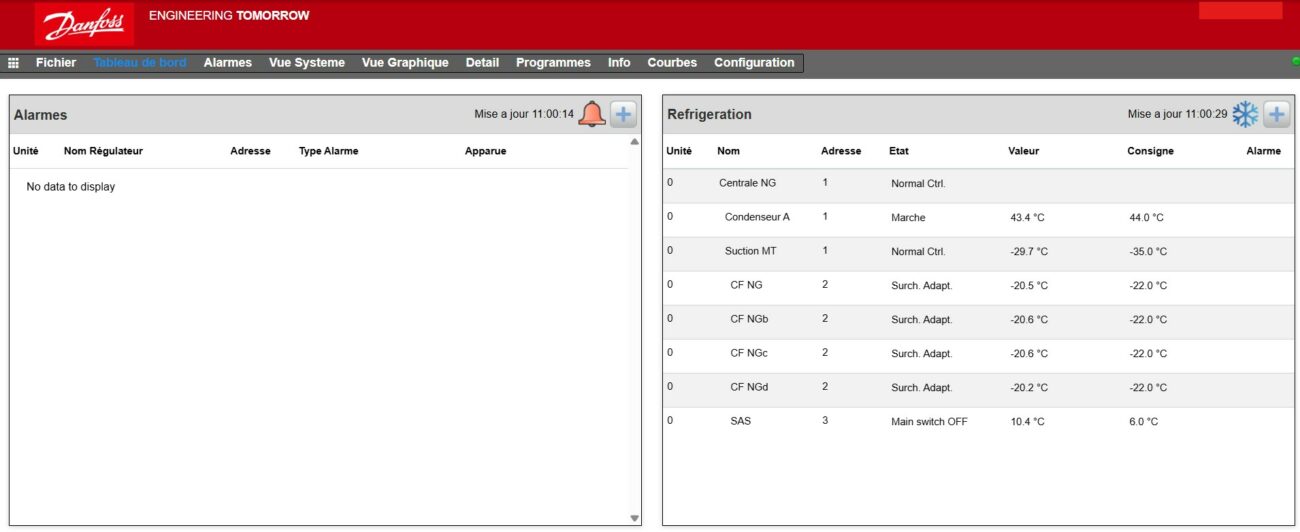
- remote monitoring of temperatures and alarms, for example with a Danfoss AK-SM 800A system manager;
- available spare parts;
- regular preventive maintenance: cleaning the condenser, checking the circuit for leaks, the door seals and defrosting.
These guarantees keep your business running, with no loss of sensitive products.
The importance of the cold chain in Côte d’Ivoire
Fish landed at the port of Abidjan, imported frozen meat and fish, mangoes and pineapples for export, dairy products, medicines and vaccines: all need an unbroken cold chain, from receipt to the customer. A well-designed cold room avoids post-harvest losses, guarantees the quality of exported products and meets local and international health standards. It is a competitive advantage for companies that want to grow in the Ivorian market and beyond.
Current trends in industrial refrigeration
- Lower-impact refrigerants: R404A, still very common, is giving way to refrigerants such as R449A, R452A, propane (R290) or CO2, depending on the size of the installation.
- Electronic control and remote supervision, which track temperatures continuously and keep a history for traceability.
- Energy savings: electronic expansion, floating condensing and variable frequency drives.
- Solar refrigeration, for sites poorly served by the grid.
The role of the supplier partner
Choosing the right cold room also means choosing a supplier able to support you over the long term. Afric Froid Côte d’Ivoire carries out the thermal study, supplies the equipment, installs and commissions the system, and maintains it.
In Abidjan, for example, we built two frozen storage cold rooms at −20 °C for meat and fish: designed for 38 °C ambient, with several compressors in parallel, redundant equipment and Danfoss AK-SM remote supervision.
Sales and after-sales service in Côte d’Ivoire: (+225) 07 11 65 93 17, africfroid.ci@frigoindus.net.
Dimensions, temperatures, products: in 2 minutes, our calculator estimates the cooling capacity, the recommended panel thickness and the electricity consumption.
Frequently asked questions
How much does a cold room cost in Côte d’Ivoire?
The price depends on the volume, temperature, panel thickness, refrigeration unit and the quantities to cool each day, so there is no single price. Send us the four pieces of information listed above and we will send you a quote. Our article on the factors that affect the price of a cold room details each item.
What panel thickness should I choose?
Generally 80 to 120 mm for a chilled room and 150 to 200 mm for a frozen storage room; the thermal study sets the thickness according to the temperature and climate. See our insulated panels.
How long does a cold room stay cold during a power cut?
A few hours if the door stays closed, depending on the insulation and how much product is stored. Beyond that, you need a generator or a cold reserve.
How often should a cold room be serviced?
At least two preventive visits a year, more near the sea or in a dusty environment, where the condenser fouls quickly. A fouled condenser increases consumption and can stop the unit in hot weather.
The cold room: a strategic investment
Choosing the best cold room in Côte d’Ivoire depends on your products, the capacity required, the site climate and the reliability of the supplier. By choosing quality, energy-efficient equipment backed by a local team, commercial and industrial companies secure their cold chain while keeping costs under control.


