


News & Projects
Coastal condensers: choosing the right anti-corrosion fin protection
A few hundred metres from the sea, the coil of an air-cooled condenser can deteriorate within a few seasons if its fins are not protected. And every extra degree of condensing temperature shows up on the electricity bill: roughly 2 to 3% more compressor consumption per kelvin. Bare aluminium, pre-coated epoxy, aluminium-magnesium alloy or post-assembly coating: here is how these options really protect the coil against corrosion, and how we choose between them on our marine-environment projects.
Why salt air destroys coils
An air-cooled condenser constantly moves thousands of cubic metres of air per hour. By the sea, this air carries chloride aerosols that settle on the fins and, with night-time humidity, form a permanent electrolyte.
Three mechanisms add up:
- Aluminium corrosion: chlorides break through the natural oxide layer and cause pitting, especially on fin edges.
- Aluminium/copper galvanic couple: in contact with the copper tube, aluminium acts as the anode and corrodes first. The fin-to-tube bond loosens, contact resistance rises, and the fin no longer transfers heat even if it still looks intact.
- Fouling: salt and dust clog the air passages and reduce airflow through the coil.
The result shows up in the condensing pressure. It rises, the compressor works at a higher compression ratio, and the installation uses more energy for the same cooling capacity. In hot weather, it eventually trips on high pressure, often at the worst time of the season.
Four ways to protect the fins
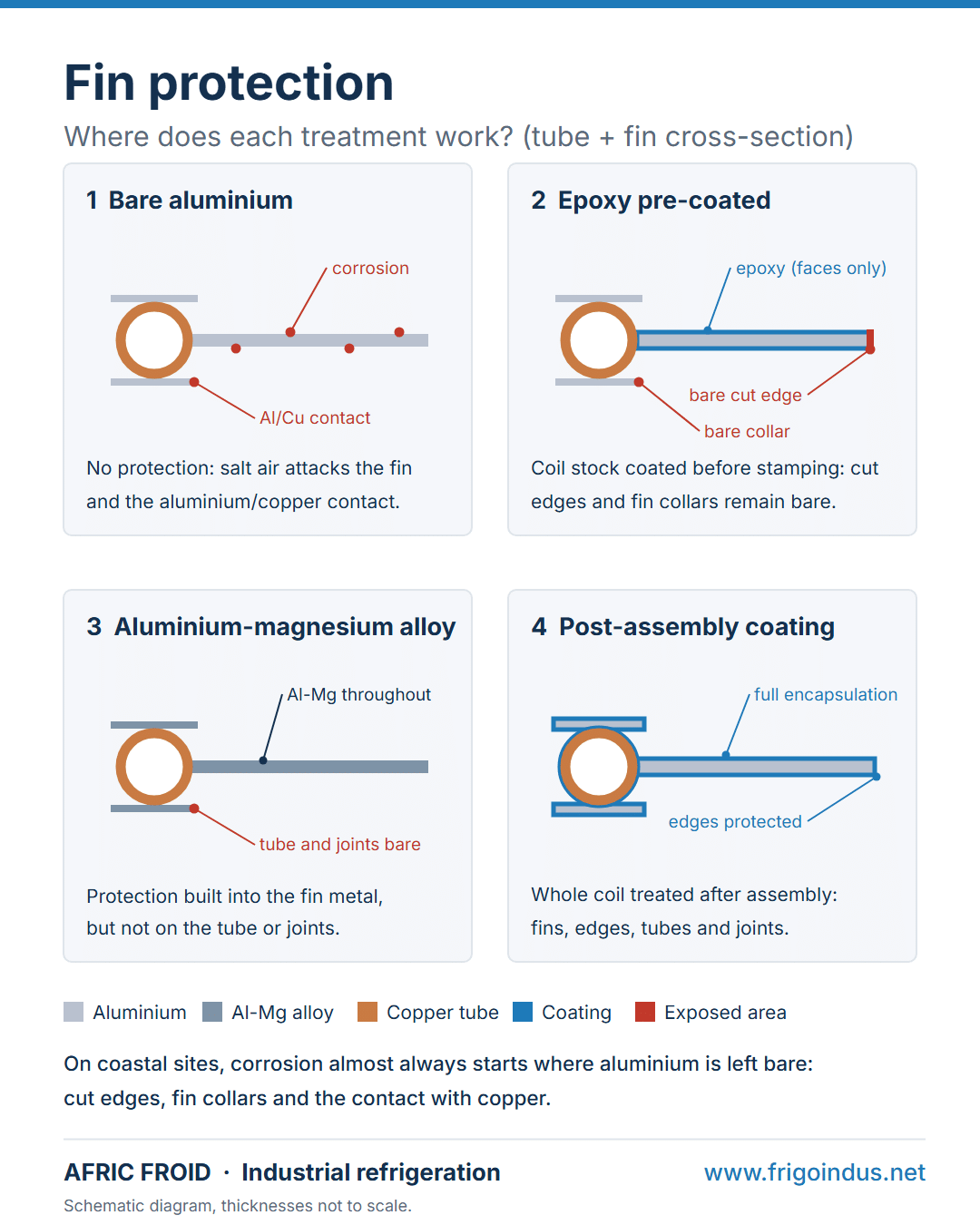
The real question is not “which treatment is best” but “where is the aluminium still bare”. That is where corrosion starts.
1. Bare aluminium
This is the standard coil, perfect inland. In a marine environment it has no defence: the fin and its contact with the copper are directly exposed.
2. Pre-coated epoxy aluminium
The aluminium coil stock is coated before being cut and pressed. The faces are protected, but the cut edges and the collars formed after coating remain bare. The film is thin and scratches during handling or aggressive cleaning. It is a good compromise at a moderate distance from the sea, but not enough for direct exposure.
3. Aluminium-magnesium (AlMg) alloy
The fin is made from an AlMg2.5-type alloy that is naturally more resistant to chlorides. The protection is in the metal itself: no film to scratch, nothing to flake. On the other hand, the extra material cost is real and the alloy does not protect the tube or joints.
4. Post-assembly coating (e-coating or spray)
The complete coil is treated after assembly, by dipping (electrocoating, also called e-coating) or by spraying. The coating covers the fins, their edges, the tubes, bends and joints. It is the most complete protection in very severe environments, provided it is applied through the full depth of the coil and any damage is touched up.
Comparison: no solution wins on every criterion
In severe marine environments (category C5 of ISO 12944), post-assembly coating offers the best corrosion resistance, but it is the most expensive and requires careful maintenance. Al-Mg alloy is the most mechanically robust.
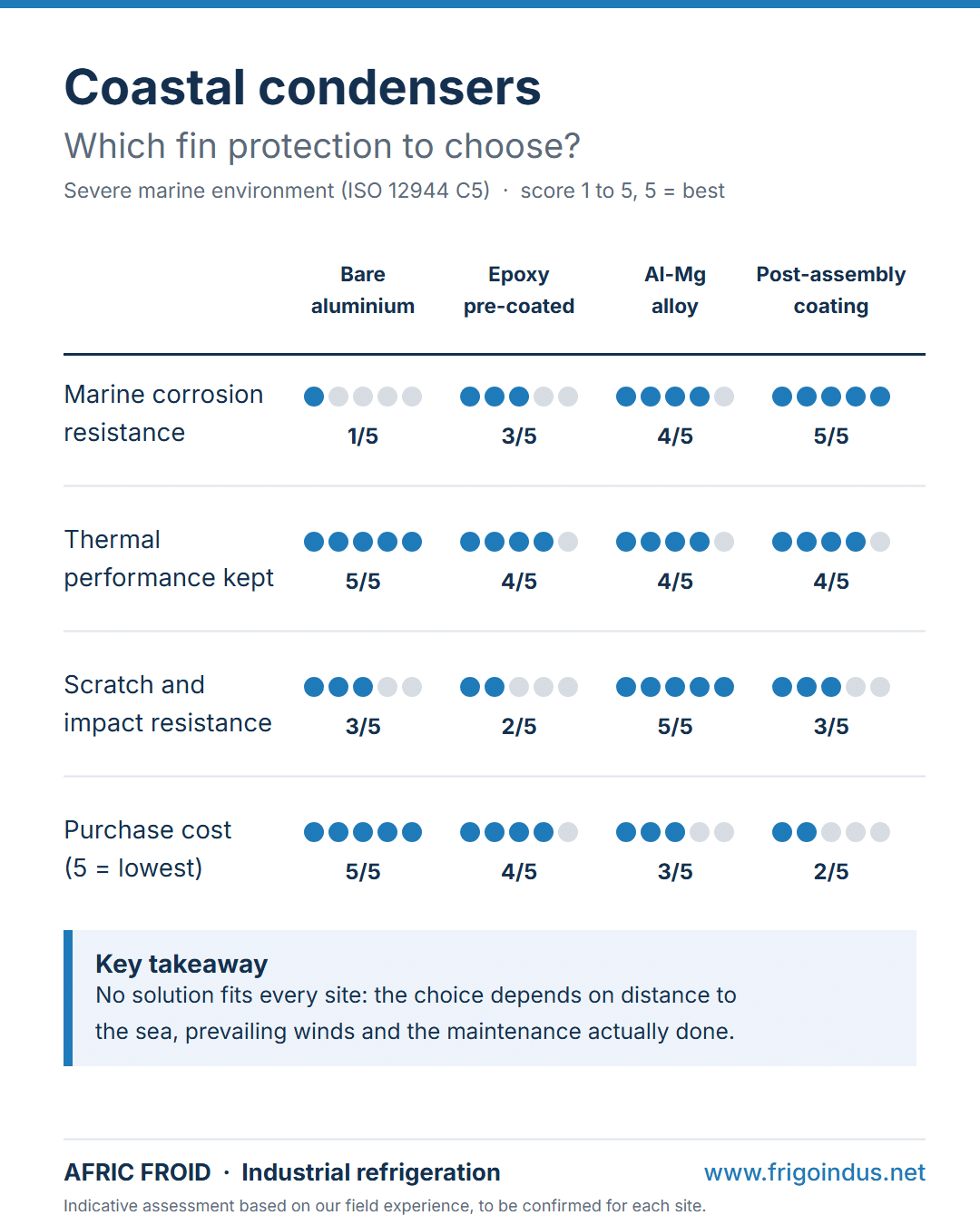
Two points the table does not show. First, a thick coating slightly reduces heat transfer, which is offset by a few percent more surface area at selection. Second, the purchase price is only part of the equation: replacing a corroded coil after three or four years costs far more than the best protection fitted from the start.
How we choose
We do not choose protection from a catalogue but from four questions asked before selecting the condenser.
- How far away is the sea, and where does the wind come from? A site 2 km away but downwind of prevailing sea winds can be more exposed than a site 800 m away sheltered behind buildings.
- Are there other aggressive factors? Industrial emissions, ammonia, fumes or port dust make the marine environment worse.
- What maintenance will actually be done? A thin protection that is perfect on paper is worthless without regular rinsing and touch-ups.
- What service life does the client expect? We think in terms of total cost over the operating life, not purchase price.
As a guide, this is how we usually steer the choice. Every site remains a special case.
| Site exposure | Usual recommendation |
|---|---|
| Seafront, direct exposure to sea spray | Post-assembly coating, with a rinsing and touch-up plan |
| Less than 1 km, downwind of the sea | Post-assembly coating or Al-Mg alloy |
| Sheltered coastal area, more than 1 km away | Al-Mg alloy or pre-coated epoxy |
| Inland, clean environment | Bare or pre-coated aluminium |
This is the grid we use to select the condensers we install, such as the Güntner FLAT Compact and Güntner FLAT Vario.
Maintenance does half the job
Even the best protection ages faster without maintenance. These steps are part of our preventive maintenance on coastal sites:
- Rinse with fresh water, at low pressure, regularly and especially after periods of onshore wind. High-pressure jets flatten fins and strip coatings.
- Inspect fin edges and joints: this is where the first white aluminium oxide deposits appear.
- Touch up straight away any scratch or flaked area of coating.
- Track the difference between condensing temperature and air temperature. If it increases from one season to the next at the same load, the coil is losing efficiency, long before it fails.
Frequently asked questions
How far from the sea does a condenser need protection?
There is no single threshold: prevailing wind and obstacles matter as much as distance. As a guide, on the seafront or less than 1 km downwind of the sea, we recommend post-assembly coating or Al-Mg alloy. Beyond 1 km in a sheltered area, Al-Mg alloy or pre-coated epoxy is usually enough.
Pre-coated epoxy or Al-Mg alloy: which one to choose?
Pre-coated epoxy protects the faces of the fins but leaves the cut edges and collars bare: it suits sites at a moderate distance from the sea. Al-Mg alloy carries the protection in the metal itself and is more robust mechanically, but it protects neither the tube nor the joints.
Does an anti-corrosion coating reduce condenser performance?
A thick coating slightly reduces heat transfer. This is offset at selection with a few percent more exchange surface.
How should a condenser be cleaned on a coastal site?
With fresh water at low pressure, regularly and especially after periods of onshore wind. High-pressure jets flatten fins and strip coatings.
How can you tell that a condenser coil is losing efficiency?
Track the difference between condensing temperature and air temperature. If it increases from one season to the next at the same load, the coil is deteriorating, long before it fails.
In summary
On a coastal site, fin protection is decided when the condenser is selected, not after the first failure. The right choice takes into account the site’s real exposure, the maintenance that can be done and the expected service life.
Afric Froid designs and installs industrial refrigeration systems across the African continent, including in harsh environments: cold rooms, freezing tunnels (such as in Dakar, for the fishing industry), refrigeration racks and condensing units. Do you have a seaside project or a coil that is deteriorating? Contact our teams for a study tailored to your site.


